Google Maps vs Apple Maps: Does It Matter Where You Optimize Your Business Listings?
Discover how and why smart multi-location brands are optimizing listings across both Google Maps and Apple Maps — and why a single-platform strategy leaves visibility (and foot traffic) on the table.

Key takeaways:
- Apple holds roughly 60% of the US smartphone market — and every one of those devices defaults to Apple Maps, not Google
- Optimizing for both platforms is largely the same work, not double the work
- Consistent business data across platforms is what feeds both traditional search rankings and AI recommendations

Ask any multi-location brand where they need to show up, and they'll answer in almost every case: Google. Google Search, Google Maps. It's where local consumers will go to check hours, get directions, or find contact details.
But we've had more and more businesses approaching us at Uberall who want a bite of the Apple — sorry for the pun.
We're obviously talking about business listings in this article — and yet, if you search "Google Maps vs Apple Maps," you’ll mostly find consumer threads: Which app has better navigation, which one has better in-app notifications, which UX is cleaner and less cluttered.
What you don’t find much of is practical advice for multi-location brands trying to understand the ideal listings management strategy — and whether being visible on both is nonnegotiable for traditional and AI search or just a nice-to-have if you have enough resources in your marketing team.
I found this Reddit thread from three years ago stating: "Apple Maps nearly 100% of the time for navigation. Google Maps when I want to look up a business for reviews, a menu, hours, etc." This is one person’s opinion from three years ago, but I think it summarizes the stigma in local marketing and quite possibly is a common reason that prevents businesses from investing time and resources into Apple Maps listings — or they've treated the platform as an afterthought in their local search strategy.
We've had more and more businesses approaching us who have realized that when it comes to Apple versus Google Maps, there's no better than; there's just better with.

Is There a Difference Between Apple and Google Maps?
Apple’s Reach
Apple doesn't dominate search — Google does right now. There's also evidence that what performs well in Google Search correlates with what performs well in AI-driven search. So, it's not surprising that Google takes front of the formation in any local search strategy.
But Apple does dominate the device — in the US, at least, where iOS holds roughly 60% of the smartphone market. In Europe, it looks as though Apple's mobile share sits at a record high of around 27%.
Mull over these numbers and remember that Apple Maps isn't just a maps app. It's the default navigation and local discovery system for every one of those iOS users — integrated into Siri, Spotlight, Wallet, and the lock screen. When someone asks Siri for the nearest coffee shop or taps an address in iMessage, that query bypasses Google. It goes straight through Apple Maps.
What makes Apple Maps different is how it pulls in reviews from third parties, from Yelp, Foursquare, and Tripadvisor. Siri is also the part worth paying attention to right now, since Apple has just introduced Siri AI: a ground-up rebuild powered by Apple Intelligence that can search the web, draw on personal context, and generate conversational answers across text, images, and local results. Apple is expected to expand these AI search capabilities into Safari and Spotlight, building an AI-powered discovery layer across its entire ecosystem. The implication for multi-location businesses is that if you're not optimizing to be discovered in Apple's ecosystem, you may not be recommended by these iOS users.
Google’s Reach
Google Maps is available on both iOS and Android — and serves over 2 billion monthly active users worldwide with millions of business listings — all integrated deeply with Google Search and Google Business Profile. Google Maps, unlike Apple Maps, hosts native reviews.
So, both Apple Maps and Google Maps influence how customers find nearby businesses, based on relevance and proximity. The real difference is that we know Google's discovery model draws heavily on search behavior data — query intent, review signals, and engagement patterns built from billions of searches. We've actually got little data on how Apple's model ranks businesses.
What we do know is that brands managing both platforms see results that positively influence their foot traffic — like REMAX Italia, which saw Apple Maps interactions jump 180% after treating both ecosystems as essential.

How Do Apple Business and Google Business Profile Compare?
Both platforms give businesses a way to control how they show up — Apple Business for Apple Maps, Google Business Profile for Google Search and Maps — but what you can control, and how, differs more than you'd expect.
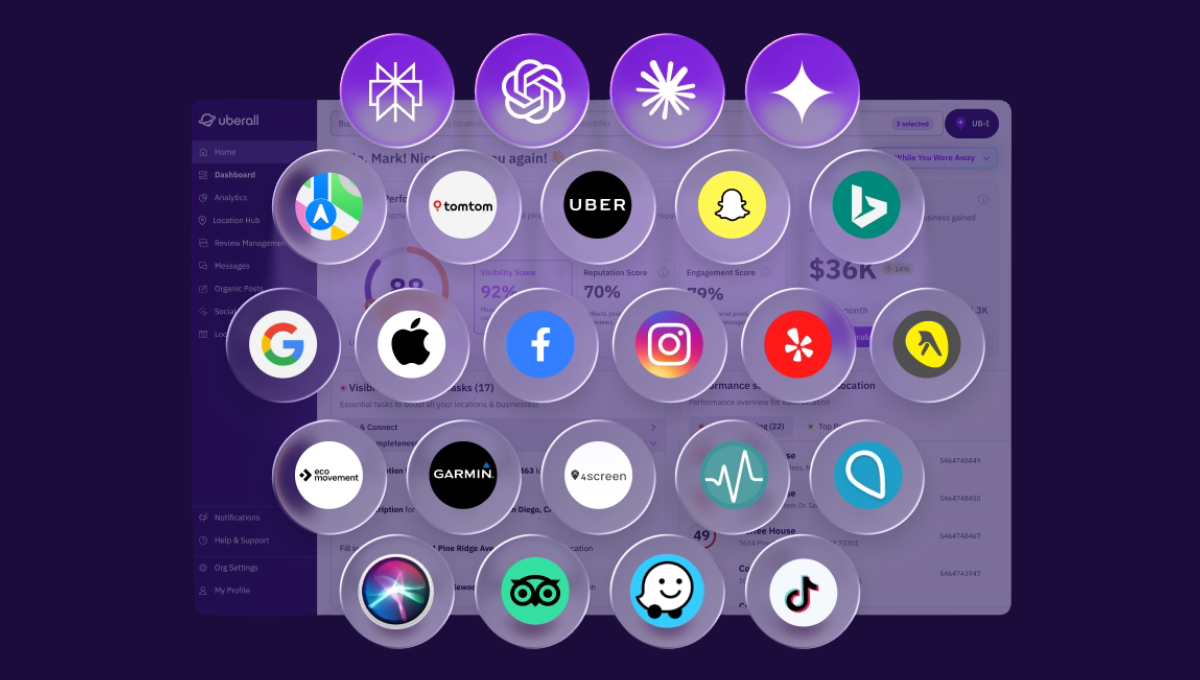
Uberall is an approved and close partner with both Apple and Google, which means multi-location brands can manage, optimize, and monitor their listings across both ecosystems from Uberall's platform. These partnerships also ensure Uberall gets early access to new features and updates, helping us bring our customers the latest innovations faster.
So, yes, Apple Business and Google Business Profile are separate systems — a verified, optimized Google Business Profile does nothing for your Apple Maps listing, and vice versa — you can manage both from a centralized dashboard with the right listings management platform. Because even if the platforms are different, the operational pain of managing them across multiple locations doesn't have to be.
Does Profile Optimization Look Different?
Your goal is to attract more foot traffic to your locations, to your stores, your restaurants, your clinics — whatever it may be. And you can hardly say you're maximizing your opportunities by leaving out a platform.
As a consumer based in Europe, a local customer, I am always surprised by how stale listings when I search for local places in Apple Maps – whether it’s grocery stores, restaurants, post office information. I'm seeing incomplete place cards, missing photos, outdated hours. I cannot help but think this is a missed opportunity for all these businesses I don’t end up visiting because I’m not confident that their business information is up to date.
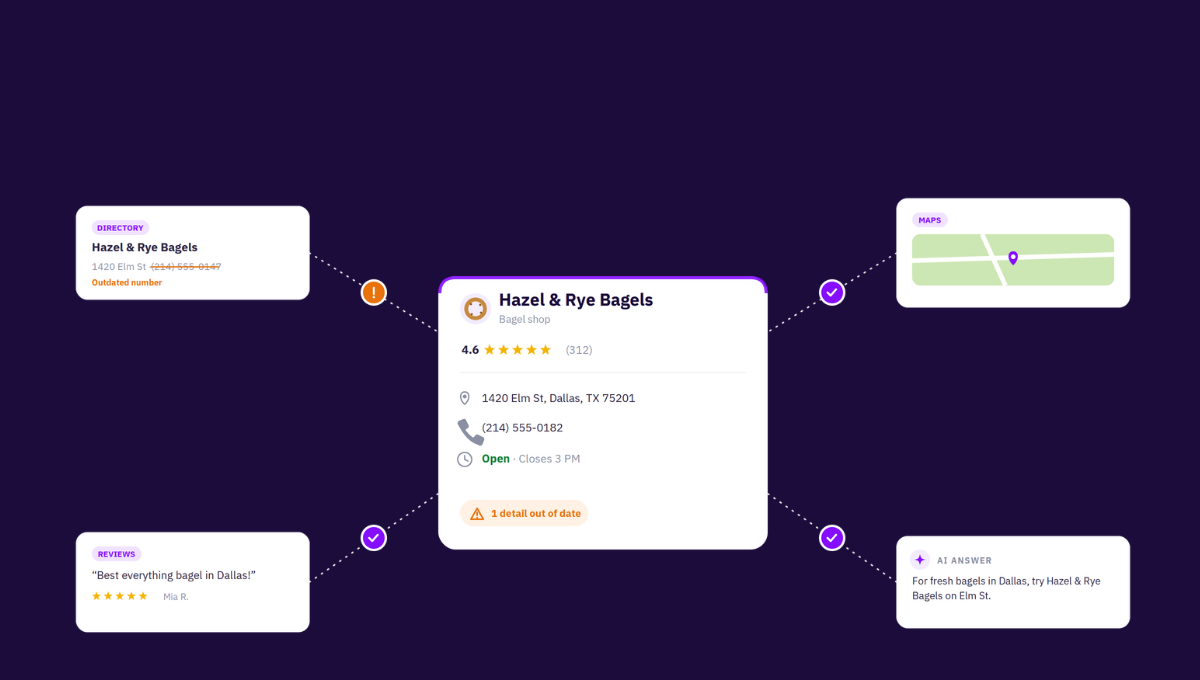
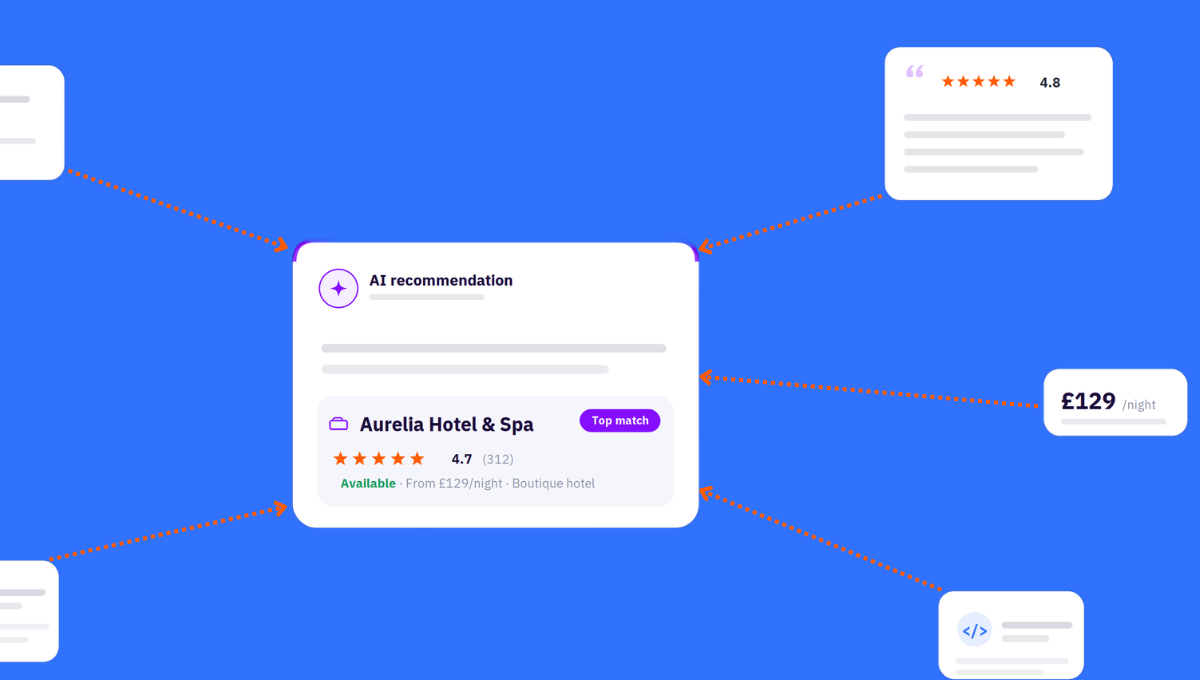
This matters even more in the context of AI search. AI models don't pull from a single platform — they identify business information from multiple sources, which means gaps or inconsistencies on any one platform can affect how (and whether) brands get recommended across all of them.
The good news for busy marketing teams is that optimizing for both platforms doesn’t have to be two separate jobs. A lot of articles out there give you separate lists on how to optimize for each platform, but the core work is largely the same — and since a platform like Uberall centralizes your optimization across Google and Apple, I'll give you a combined list for both platforms.
- Verify or claim your listings at business.google.com or businessconnect.apple.com. This is the first step, where you fill in your NAP information, with your website information. Apple's place card and Google's Business Profile both reward completeness, and both penalize inaccuracy. Select accurate categories and attributes. Add payment information and buttons. Keep your hours updated – especially for holidays.
- Add high-quality photos of your logo, location interior and exterior, products (or dishes). Add these regularly to show local customers that your business is active and to highlight the visitor's experience.
- Publish relevant promotional posts regularly through Google Posts or Apple Showcases. Incorporate clear calls-to-action to encourage customers to make a booking or visit you. These should be location-specific as much as possible, rather than generic.
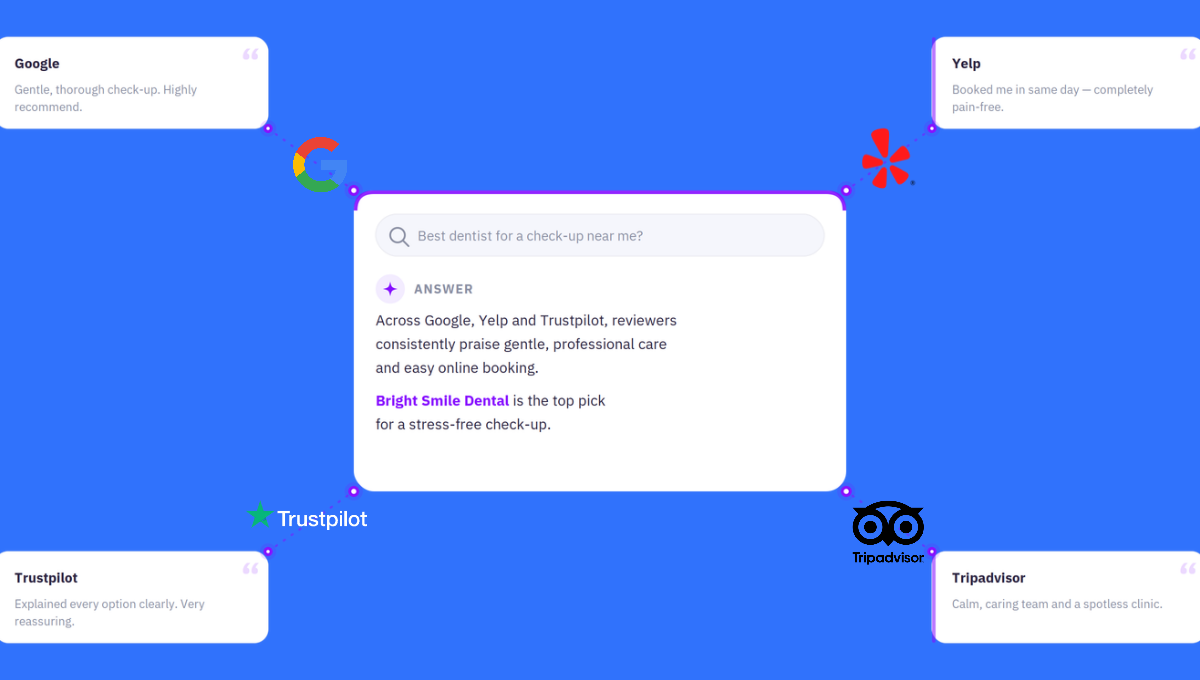
- Monitor and manage reviews regularly — whether they're positive or negative. This shows customers (whether existing or returning) that you're engaged and it's also a very critical ranking factor for traditional search — and a trust signal for AI search. Apple Maps pulls reviews from Yelp, Foursquare, and Tripadvisor, so maintaining a strong presence on those platforms feeds directly into your Apple Maps visibility.
- Consider ads to drive more traffic to your location — Google Ads has long been the go-to for local paid visibility, but the landscape just expanded: Apple Maps is introducing ads this summer in the US and Canada, letting businesses bid on relevant search terms to appear at the top of Maps results. The model is auction-based and privacy-first, and for multi-location brands, it opens up a paid discovery channel that simply didn't exist before — reaching high-intent local searchers who never pass through Google.
- Gain insights into how your listings are performing — both platforms offer reporting, and teams can track performance in Uberall's platform. Google's is more granular, split by awareness (impressions and keywords), interactions (clicks and conversions), conversion rates, and ratings. Apple's analytics lets users see total views, interactions, and taps to locations — and also these insights on a location level. Users can also see search insights from previous searches. Data from both platforms will give businesses a richer understanding of how customers are finding and interacting with their locations, and how to make data-driven marketing decisions accordingly.

Reputation management, presence management, review strategy — none of these are platform-native. They matter for every local search platform, how businesses are seen as a trusted, consistent entity, and they matter for how customers discover local businesses. The brands that treat optimization as an entity-level discipline, rather than a platform-by-platform checklist, are the ones that are going to show up in Google, Apple, ChatGPT.
There’s No Better Than, Just Better With
Your customers don't all discover your business the same way. Some start with Google Search. Some ask Siri. Some tap an address in a text message. And increasingly, they'll ask an AI assistant like ChatGPT that pulls from multiple sources before recommending a single place.
You can't assume they'll all come through Google — and you can't afford to be invisible on the one they happen to use. In fact, they might come from multiple platforms until they trust you.
So, the question isn't which platform delivers better local marketing results: Apple or Google. It's whether your business shows up accurately on both and engages customers across both. Underlying business data is what feeds not only AI recommendations but also customer trust — and inconsistent or stale business information won't win anywhere.



1,800 brands trust us to stay visible
— not just show up once or twice in local search.


Frequently asked questions
The difference between Apple Maps and Google Maps comes down to reach and reviews. Google Maps runs on iOS and Android, serves 2B+ monthly users, hosts native reviews, and ties into Google Search and Business Profiles. Apple Maps is the default on every iPhone — integrated with Siri, Spotlight, and Wallet — and pulls reviews from third parties like Yelp, Foursquare, and Tripadvisor. Apple Maps is Apple’s own product, not based on Google.
Neither is simply better — for businesses, it’s not "better than," it’s "better with." Google dominates search and local discovery, while Apple owns the device. Nearly 60% of US smartphones are iPhones that default to Apple Maps. The honest answer depends on your audience, and most multi-location brands can’t afford to be invisible on either one.
Google Maps serves more than 2 billion monthly active users worldwide across iOS and Android. Apple doesn’t publish Apple Maps usage figures, but the reach is large by default: iPhones hold roughly 60% of the US smartphone market, and every one defaults to Apple Maps for navigation, Siri, and Spotlight. So Google leads on total reach, while Apple owns a huge, high-value slice of iOS users.
Yes, you should add your business to Apple Maps. Apple shows your information whether or not you claim it, so claiming lets you control accuracy, imagery, and how you appear across the Apple ecosystem. With most competitors not yet active, optimizing now wins visibility in a low-competition space — brands have seen up to 20% more clicks after optimizing their Apple listings.
Apple Business and Google Business Profile are separate systems. Optimizing one does nothing for the other. Both let you control media, categories, actions, and reviews, but the details differ. Google’s categories tend to be more specific, its insights more granular, and its partner ecosystem wider, while Apple limits third-party management to approved partners. Verification on both can take up to five business days.
Yes, you should optimize for both Apple and Google Maps. AI tools and search engines pull business data from multiple sources, so a gap or inconsistency on one platform can hurt how you’re recommended across all of them. The good news is that the core work, including accurate NAP, photos, posts, reviews, is largely the same on both, especially if you manage them from one platform.
No, Apple Maps is not based on Google Maps. Apple rebuilt its own mapping data and pulls business reviews from third parties like Yelp and Tripadvisor. On accuracy, navigation and ETAs are near-identical in major markets. Google still leads on the sheer density of business listings and crowd-sourced data, so it can edge ahead in rural areas and outside North America and Western Europe.
The best way to manage multiple locations on maps platforms like Google and Apple is a single listings platform that partners with both. Because Apple limits management to approved partners, you’ll want a tool like Uberall — an approved Apple and Google partner — to claim, optimize, and monitor both ecosystems from one dashboard. That keeps your data consistent across platforms without doubling the manual work for your team.
The difference between Apple Maps and Google Maps comes down to reach and reviews. Google Maps runs on iOS and Android, serves 2B+ monthly users, hosts native reviews, and ties into Google Search and Business Profiles. Apple Maps is the default on every iPhone — integrated with Siri, Spotlight, and Wallet — and pulls reviews from third parties like Yelp, Foursquare, and Tripadvisor. Apple Maps is Apple’s own product, not based on Google.
Neither is simply better — for businesses, it’s not "better than," it’s "better with." Google dominates search and local discovery, while Apple owns the device. Nearly 60% of US smartphones are iPhones that default to Apple Maps. The honest answer depends on your audience, and most multi-location brands can’t afford to be invisible on either one.
Google Maps serves more than 2 billion monthly active users worldwide across iOS and Android. Apple doesn’t publish Apple Maps usage figures, but the reach is large by default: iPhones hold roughly 60% of the US smartphone market, and every one defaults to Apple Maps for navigation, Siri, and Spotlight. So Google leads on total reach, while Apple owns a huge, high-value slice of iOS users.
Yes, you should add your business to Apple Maps. Apple shows your information whether or not you claim it, so claiming lets you control accuracy, imagery, and how you appear across the Apple ecosystem. With most competitors not yet active, optimizing now wins visibility in a low-competition space — brands have seen up to 20% more clicks after optimizing their Apple listings.
Apple Business and Google Business Profile are separate systems. Optimizing one does nothing for the other. Both let you control media, categories, actions, and reviews, but the details differ. Google’s categories tend to be more specific, its insights more granular, and its partner ecosystem wider, while Apple limits third-party management to approved partners. Verification on both can take up to five business days.
Yes, you should optimize for both Apple and Google Maps. AI tools and search engines pull business data from multiple sources, so a gap or inconsistency on one platform can hurt how you’re recommended across all of them. The good news is that the core work, including accurate NAP, photos, posts, reviews, is largely the same on both, especially if you manage them from one platform.
No, Apple Maps is not based on Google Maps. Apple rebuilt its own mapping data and pulls business reviews from third parties like Yelp and Tripadvisor. On accuracy, navigation and ETAs are near-identical in major markets. Google still leads on the sheer density of business listings and crowd-sourced data, so it can edge ahead in rural areas and outside North America and Western Europe.
The best way to manage multiple locations on maps platforms like Google and Apple is a single listings platform that partners with both. Because Apple limits management to approved partners, you’ll want a tool like Uberall — an approved Apple and Google partner — to claim, optimize, and monitor both ecosystems from one dashboard. That keeps your data consistent across platforms without doubling the manual work for your team.